Enhanced Electrochemiluminescence for Monitoring of Therapeutic Antibodies

Enhanced Electrochemiluminescence for Monitoring of Therapeutic Antibodies

Introduction

Selina Weingärtner, Dr Michael Adler, Dr Ralph Maier

Bispecific T-cell engagers (TCEs) are engineered immunotherapeutics that redirect T-cells to target cells and induce potent cytotoxic response. Comprehensive characterization requires assessment of drug concentration, immunogenicity, target engagement, neutralizing activity, and stability. To reduce assay complexity, minimizing number of labeled components is essential. Using a unified detection platform, a small number of labeled reagents can support a broad range of therapeutic antibody assay formats.

Here, we present an electrochemiluminescence (ECL)-based platform, utilizing three labeled components (anti-idiotypic antibody, drug target and drug) to support multiple assay formats. Recent advances in ECL signal enhancement further improve sensitivity and were therefore evaluated regarding both analytical performance and matrix compatibility. The resulting expansion of the measurable signal range increases the information content obtained from each measurement.

A tailored ECL assay panel enables comprehensive characterization of a therapeutic drug within one analytical platform.
Ask the Scientists
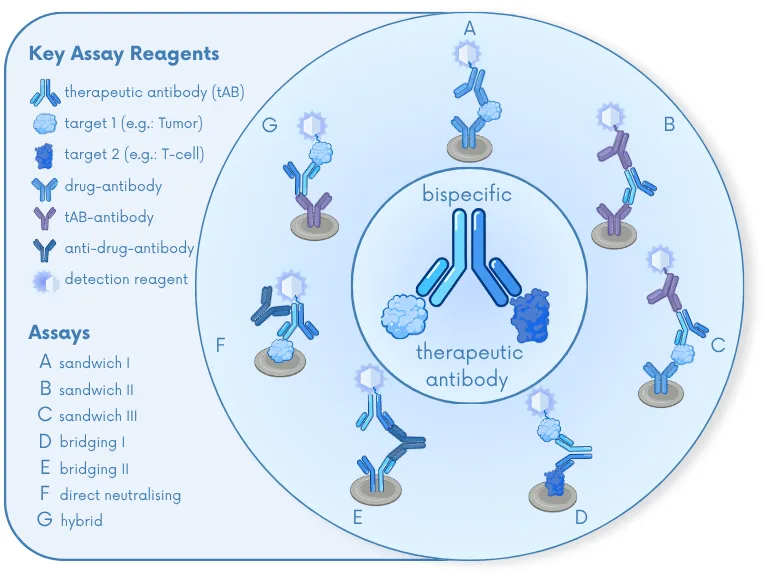
therapeutic antibody (tAB) target 1 (e.g.: Tumor) target 2 (e.g.: T-cell) drug-antibody tAB-antibody anti-drug-antibody detection reagent

MSD Assay overview

(A) Sandwich immunoassay I (Free drug target)

Anti-target capture and detector antibodies enable quantification of drug target. If labeled drug is applied as detector, only free target not already bound to drug will be detected.

(B) Sandwich immunoassay II (Total drug)

Quantification of total drug concentration using anti-idiotypic capture and detector antibodies.

(C) Sandwich immunoassay III (Bound drug)

Quantification of drug-target complexes using anti-target capture and anti-drug detection.

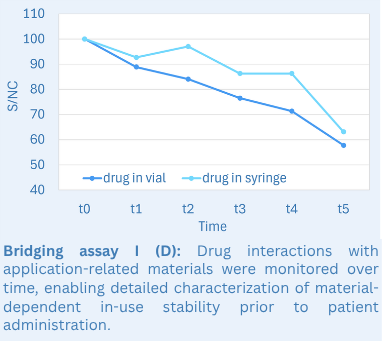
(D) Bridging immunoassay I (Free Drug)

Quantification of functionally active, target-binding drug using the targets as capture and detector.

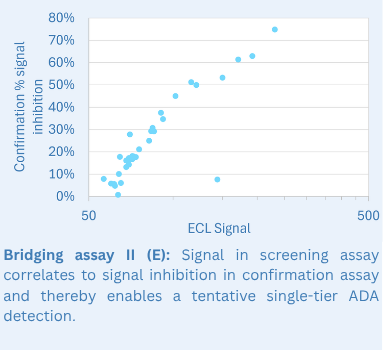
(E) Bridging immunoassay II (ADA)

Detection of anti-drug antibodies (ADA) using the drug as capture and detector. For therapeutic antibodies, potential interference by free target should be evaluated in parallel to drug interference.

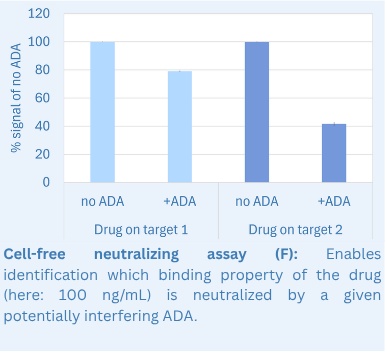
(F) Neutralization assay

Immobilized target and labeled drug enable detection of factors interfering with drug-target interaction, including neutralizing ADA.

(G) Hybrid immunoassay

Highly selective assay combining anti-idiotypic recognition and target binding to confirm drug integrity and functionality.

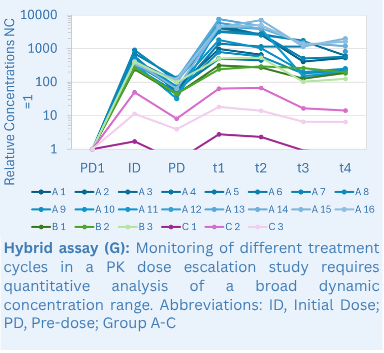
Hybrid assay
Bridging assay II
Cell-free neutralizing assay
Bridging assay I
Ask the Scientists

Methodology

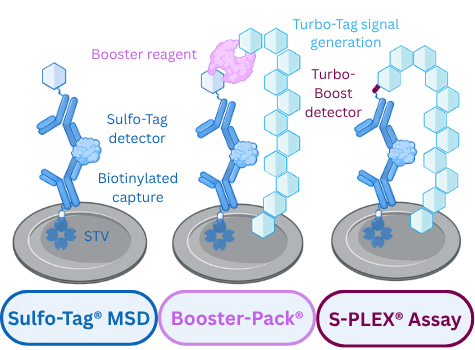
Sulfo-Tag®–labeled detector proteins generated ECL signals upon electrical stimulation.

Turbo-Boost amplification was applied either via Booster Pack® reagents or direct detector conjugation, resulting in formation of Turbo-Tag® signal complexes.

Biotinylated capture reagents were immobilized on streptavidin (STV)-coated ECL plates, where electronic current at the electrode surface initiates signal generation.


Turbo-Boost labeling of IgG and non-IgG assay reagents:

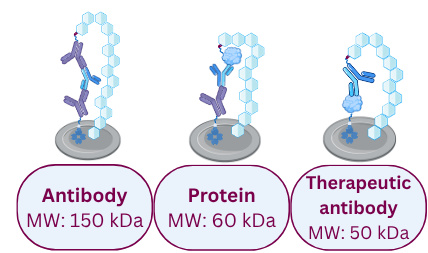
While conventional sandwich assays typically rely on labeled detection antibodies, comprehensive therapeutic antibody characterization requires labeling of diverse assay reagents.The S-PLEX® Turbo-Boost protocol, originally developed for ~150 kDa IgG molecules, was adapted for proteins of varying size and supplemented with a generalized labeling calculator.

To demonstrate the flexibility of this approach, a drug-specific antibody, TCE drug, and drug target were successfully labeled and confirmed functional.

The adapted workflow broadens the applicability of S-PLEX® technology for therapeutic antibody characterization.

Ask the Scientists
S-PLEX® Assay
Antibody MW: 150 kDa Protein MW: 60 kDa Therapeutic antibody MW: 50 kDa

Extended sensitivity – Application examples

Booster-Pack®

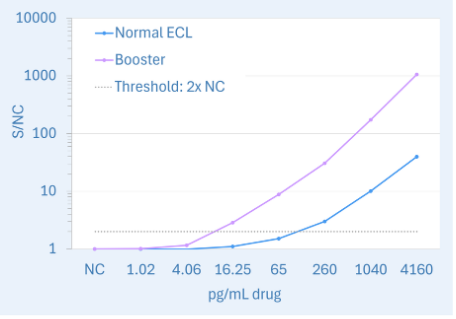
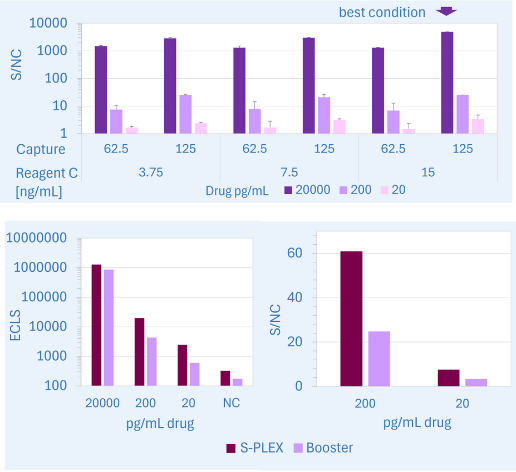
A hybrid assay (G) was used to compare ECL sensitivity with and without Booster® reagent enhancement using serial dilutions of a TCE drug in buffer.

Compared with conventional optimized ECL, Booster® improved assay sensitivity by more than one order magnitude and substantially increased signal intensity.

Ask the Scientists
MSD Booster-Pack®

Booster® & Matrix

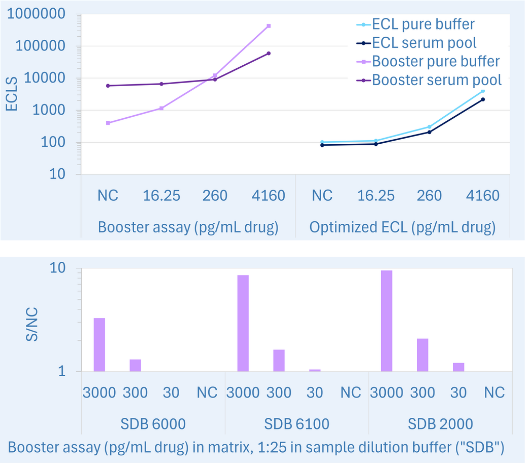
An optimized conventional ECL assay (hybrid assay, G) was compared with a preliminary Booster® assay format.

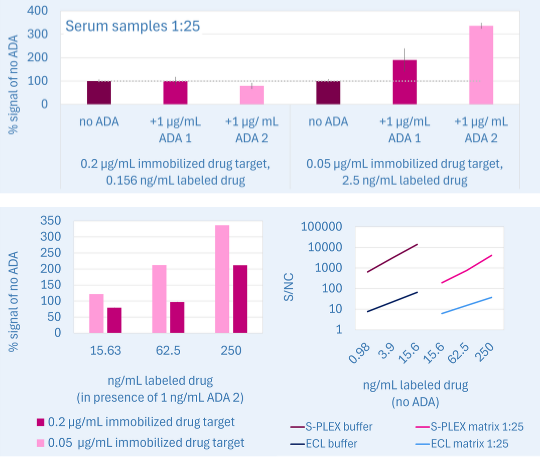
While ECL Booster® generated substantially higher signals in buffer, increased susceptibility to matrix-derived background was observed. Matrix interference therefore requires careful assay optimization, including appropriate sample dilution.

Ask the Scientists
MSD Booster® & Matrix

S-PLEX® Assay

A neutralization assay (F) confirmed full functionality of the Turbo-Boost labeled drug. Signal response correlated linearly with immobilized drug concentration (R2 > 0.99) across more than three orders of magnitude, demonstrating the broad dynamic range of ECL platform and the strong signal enhancement achieved with S-PLEX®.

Ask the Scientists
S-PLEX® Assay

Booster® vs. S-PLEX®

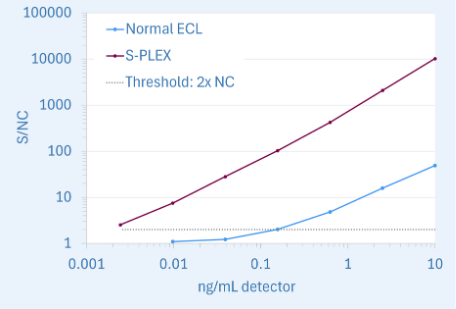
Performance of Booster® and S-PLEX® formats was compared in a model hybrid assay (G). While the Booster® achieved robust performance at low reagent concentrations, direct labeling in S-PLEX® further increased signal intensity, signal-to-background ration and overall assay sensitivity.

For both Booster® and S-PLEX® a systematic variation of reagent concentrations was evaluated to optimizes performance.

Ask the Scientists
Booster® vs. S-PLEX

Neutralization

For optimization of a neutralizing assay (F) careful titration of immobilized drug and labeled detector concentration (Turbo-Boost® labeled drug) is necessary to correctly identify the ADA-drug interaction. The impact of ADA on assay signal depended strongly on assay stoichiometry and could manifest as either signal suppression or signal enhancement.

In this assay setup, S-PLEX® achieved superior S/NC ratios in both buffer and matrix. Matrix interference was addressed by protocol adaptation (1:25 sample dilution in adequate buffer), demonstrating that high assay sensitivity of the S-PLEX® technology does not inherently compromise matrix compatibility.

Ask the Scientists
MSD Neutralization Assay

Protein vs. Antibody

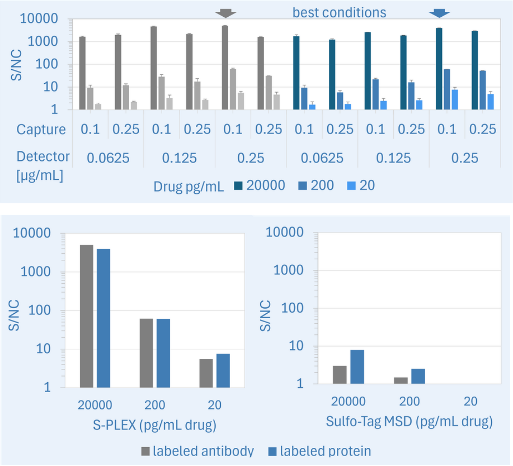
A hybrid assay (G) and sandwich assay (B) were used to compare Turbo-Boost labeled anti-idiotypic antibodies and drug-target proteins as detector reagents. Both retained full functionality and enabled robust performance at low reagent concentrations.

While conventional ECL showed detector-dependent differences , these were less pronounced in S-PLEX®, which provided S/NC improvements of several orders of magnitude.

These findings demonstrate that S-PLEX® assay performance cannot be directly predicted from conventional ECL data and requires dedicated optimization.

Ask the Scientists
Protein vs. Antibody Assay

Summary & Conclusion

The presented ECL-based platform provides a versatile solution for integrated characterization of bispecific T-cell engagers (TCEs). By combining multiple assay formats within a single analytical framework and utilizing only three labeled reagents, diverse parameters including drug exposure, target engagement, immunogenicity, and neutralizing activity can be assessed efficiently. Booster® and S-PLEX® technologies further expand assay sensitivity and dynamic range, enabling robust analysis of low-abundance analytes while reducing sample and reagent consumption. Although assay-specific optimization is required, these technologies offer a powerful and scalable approach for comprehensive therapeutic antibody characterization.

Selina Weingärtner
Ask Selina Weingärtner
Projektmanager Projectmanager PK PD ADA AnB LBA Assay
Ask Dr. Ralph Maier
Dominique Paetz biotec
Ask Dominique Paetz

Cost efficiency

Reduce your internal costs and benefit from our specialized expertise. Our bioanalytical services include a variety of assays tailored to your specific requirements. By outsourcing your projects to us, you save costs and resources. Rely on our experience in the field of bioanalytical services.

Learn more

Time saving

Accelerate your projects with our efficient processes and fast turnaround times. Our bioanalytical services include a wide range of assays tailored to your specific needs. By outsourcing your projects to us, you save valuable time. Use our expertise for your research.

Learn more

Access to state-of-the-art technology

Take advantage of our state-of-the-art laboratories and technologies without having to invest yourself. Our bioanalytical services include a variety of assays tailored to your specific requirements. By outsourcing your projects to us, you benefit from state-of-the-art technology. Rely on our experience in the field of bioanalytical services.

Learn more

Unmatched Synergy in Ultra-Sensitive Immunoassays

Harnessing the Power of Imperacer® and AnySource® Technologies for Precise Biomarker Quantification

The combination of Chimera Biotec GmbH’s Imperacer® platform and AnySource® technology offers an outstanding synergy for ultra-sensitive immunoassays. Imperacer® enables up to 1000-fold signal amplification through its DNA-antibody conjugates, while AnySource® optimizes sample dilution and minimizes background noise. Together, these technologies allow precise analyses even with minimal sample volumes and in complex matrices. This results in high sensitivity and accuracy in biomarker quantification.

Ask our Scientist Team

Enhanced Electrochemiluminescence for Monitoring of Therapeutic Antibodies Sulfo-Tag® MSD Booster-Pack S-PLEX® Assay Meso Scale Discovery

Experience the power of biotechnology – learn more now!

Unlock the potential of advanced biotech.